


The Rules of Online Poker
Poker, whether you’re playing online or in the casino, can be a complex game, combining strategy, skill, and psychology in one card game.
The basic objective is to make the best five-card hand from a combination of your cards and shared community cards. But there’s more to it than just that, and if you are a beginner, you should first get familiar with the rules of poker.
In our poker rules guide, we look at how to play Texas Hold’em, which is the most popular version of poker.
We'll introduce you to:
- The hand rankings you need to memorize.
- The basic rules that govern every hand.
- How betting rounds work.
- When to act and what to do.
Winning at Poker: Making the Best Poker Hand
What determines who wins a game of poker? Although it can differ between each type of poker, if you are playing Texas Hold'em, it’s all down to making the best five-card hand with a combination of your hole cards and the community cards. The quality of your hand is determined by the hand rankings.
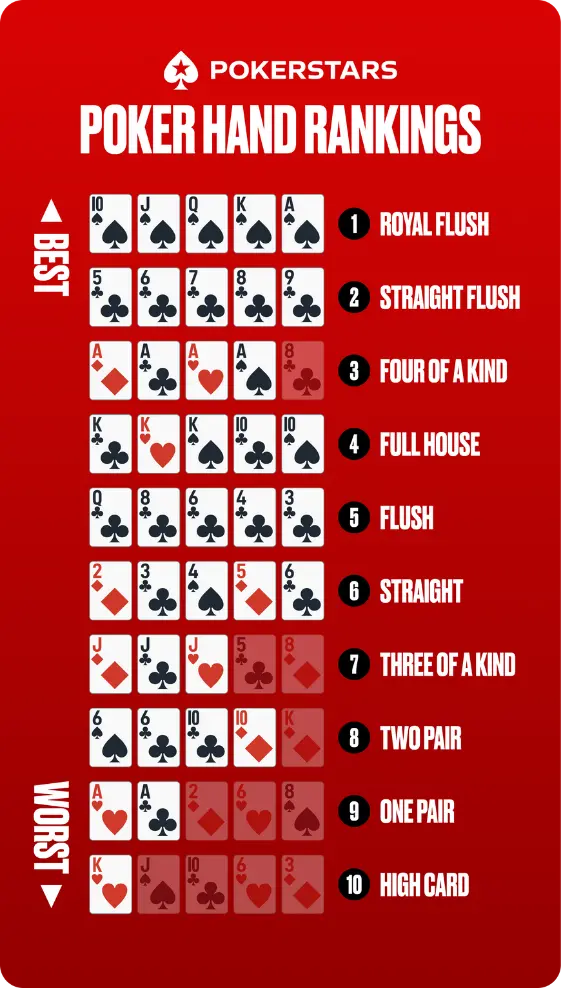
But before we get to how to improve your chances of winning, let’s look at how a typical game works. Again, we are using Texas Hold’em for our example game, but most of the gameplay and rules apply to other versions of poker.
How to Start Playing Poker
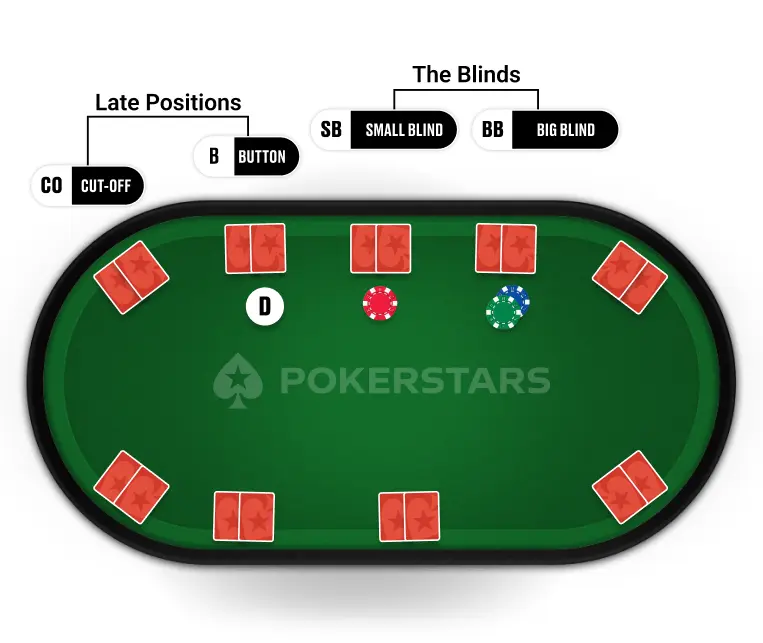
Poker games typically feature a forced bet, known as ‘blinds’. These are divided into the ‘Big Blind’ and ‘Small Blind’ in Texas Hold'em and Omaha poker. These bets are made by the two players to the left of the ‘Button’, which marks the dealer (or the player acting as the dealer).
Find out more about position and why it’s important when playing poker with our video guide: (in Spanish)
In any given hand of poker, these forced bets make up the starting pot. Without the blinds, there would be no incentive for players to make bets. The subsequent rounds of betting further increase the size of the pot.
At the start of each new round, the button rotates one to the left of the current player with the button. The Small Blind and Big Blind also move in the same way.
Dealing Cards
Each player is dealt a specific number of cards, which is different depending on which version of the game you are playing. In Texas Hold’em, you receive 2 cards, whilst in Omaha, you’ll get 4 cards. These cards are known as ‘hole cards’.
Once the initial cards are dealt, it’s time to bet. Players are usually called upon to act in turn, moving clockwise around the table.
What happens to the other cards in the deck? An additional five cards are dealt through the various rounds of betting. These cards, known as the ‘community cards’, are placed face up in the middle of the table.
Betting Rounds
Texas Hold’em and Omaha are the two most popular poker games in the world and have identical betting structures, with four rounds of betting known as the Pre-Flop, the Flop, the Turn, and the River.
Pre-flop
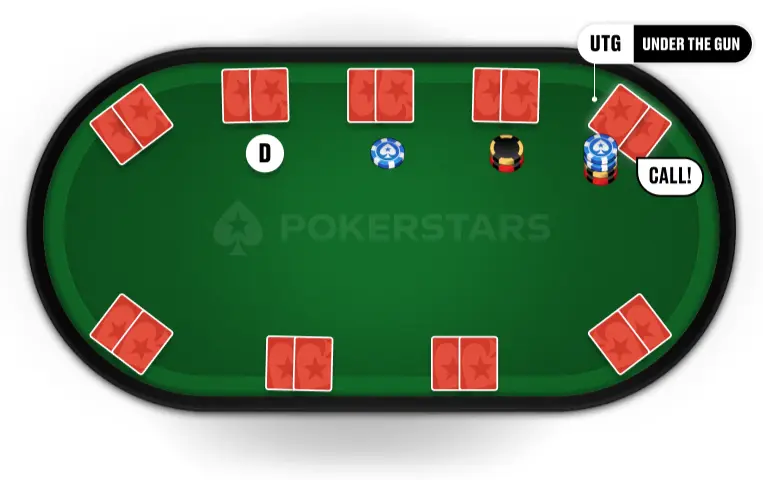
The pre-flop betting round begins as soon as all players have received their hole cards, before any community cards have been dealt.
The first player to the left of the Big Blind acts first, and must either match the amount of the Big Blind (call), raise to increase the bet (which must be at least twice the amount of the Big Blind), or fold and throw their hand away.
The other players have the same three options - to call, raise or fold.
The Flop
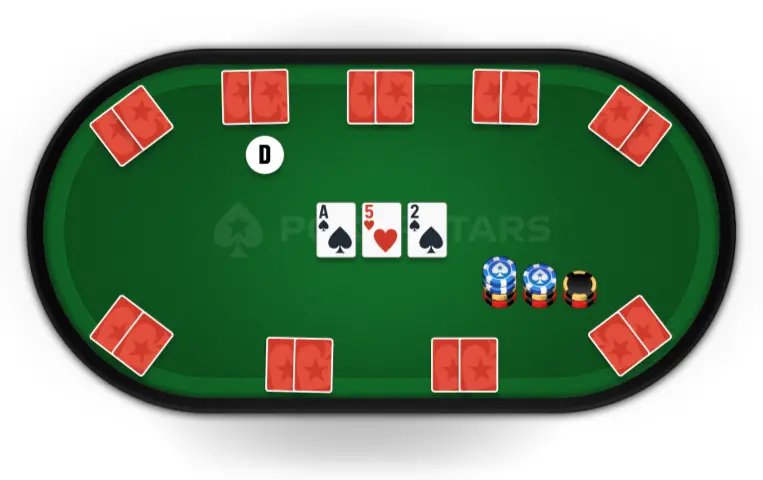
The flop begins with three community cards being dealt face up on the table from the top of the deck (after one card is ‘burned’ and removed). This round gives players their first opportunity to form the best five-card hand using their hole cards and the community cards.
Betting on the flop occurs after the first three community cards are dealt. Players have the same options for what action to take, but can now also ‘check’, which means passing the action onto the next player.
The Turn
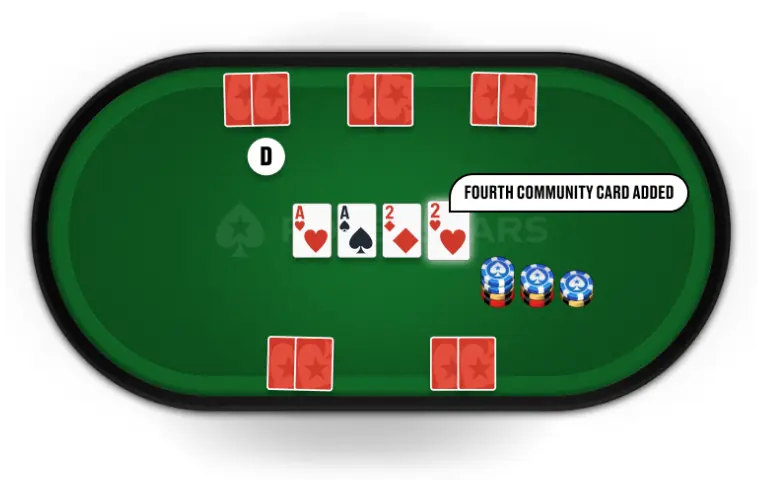
The turn reveals the fourth community card. Once again, players can check, bet, call, raise or fold.
The River
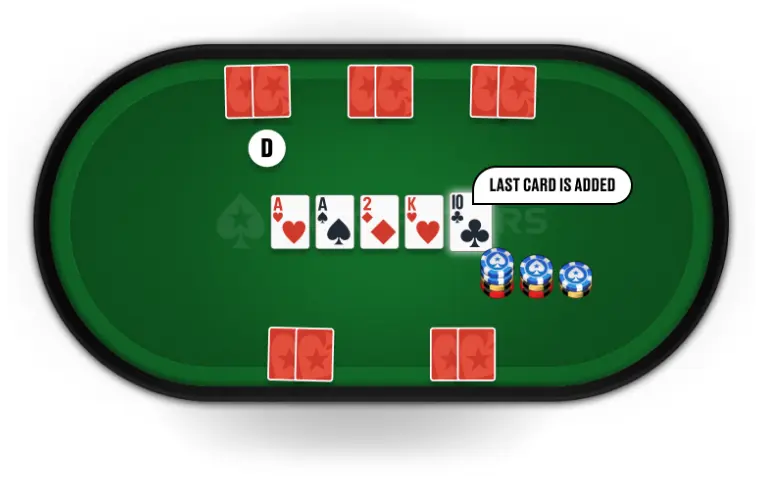
The fifth and final community card is dealt face up, and the final round of betting begins.
Betting in Poker
A key fundamental of poker is betting. Each player can usually take one of the following actions when it is their turn to bet:
- Check – To check is to decline the opportunity to open the betting. Players can only check when there is no bet during the current round, and the act of checking passes the action clockwise to the next person in the hand. If all active players check, those players remain in the hand and the round is considered complete.
- Bet – Players may bet if no other players have bet during the current round. Once a bet has been made, other players must ‘call’ by matching the amount bet, in order to remain in the hand.
- Fold – Players who fold forfeit their cards and cannot win or act again during the current hand.
- Call – Players can call if other players have bet during the current round; this requires the calling player to match the highest bet made.
- Raise – Players may raise if other players have bet during the current round; this requires the raising player to match the highest bet made, and then make a greater one. All subsequent players are required to call the raise or raise again (‘re-raise’) to stay in the hand.
Showdown
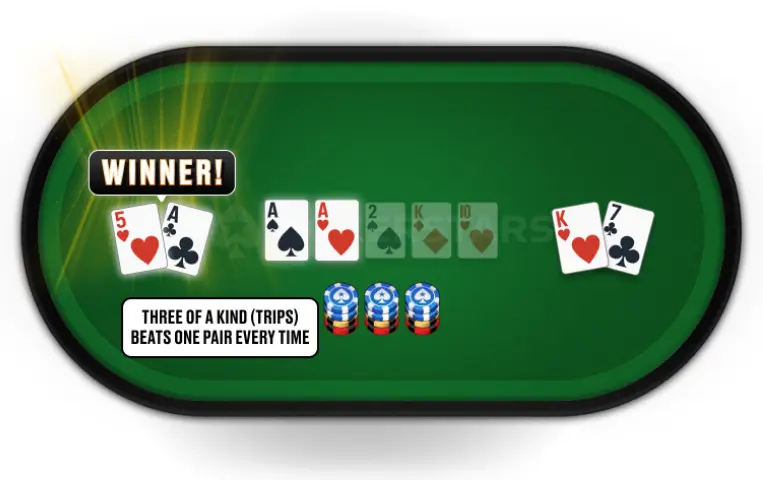
Once the last bet or raise has been called during the final round of betting, a showdown occurs. This means that the remaining active players must show or ‘declare’ their hands, and the player(s) with the best ranking hand(s) win the pot.
Players often show their hands in order, rather than all at the same time. Players can have the same hand, which means that in some scenarios, the pot is shared. The pot is divided in different ways depending on the game rules and how each player’s hand ranks against their opponents.
If there is only one player left before the showdown, then that player automatically wins the pot, and there is no need to have the final reveal.
Betting Limits
Betting limits refer to the amount players may make their first bet with (called the ‘open’), as well as raise. Typically, poker games are of the following types; no limit, pot limit or fixed limit.
- No Limit – in poker games with a no limit betting structure, each player can bet or raise by any amount up to and including their full stack (the total number of chips they possess at any given time) in any betting round, whenever it is their turn to act.
- Pot Limit – in poker games with a pot limit betting structure, each player can bet or raise by any amount up to and including the size of the total pot at that time.
- Fixed Limit – in poker games with a fixed limit betting structure, each player can choose to call, bet or raise, but only by a fixed amount. The fixed amount for any given betting round is set in advance.
For No Limit and Pot Limit games, the ‘Stakes’ column in the PokerStars lobby indicates the Small Blind and Big Blind in that game.
For Mixed Games, the Stakes listed in the lobby are the betting amounts for Limit games; in Pot Limit and No Limit rounds, the blinds are usually half of the blinds in limit games.
Table Stakes and All-in
You may have seen a poker scene in a movie or on TV where a player is faced with a bet for more chips than they have at the table, and is forced to wager a watch, a car or some other possession in order to stay in the hand. This may make for good drama, but it is not generally the way poker is played in real life!
All games on our site are played ‘table stakes’, meaning only the chips in play at the beginning of each hand can be used during the hand. The table stakes rule has an application called the ‘All-In’ rule, which states that a player cannot be forced to forfeit a poker hand because the player does not have enough chips to call a bet.
A player who does not have enough chips to call a bet is declared All-In. The player is eligible for the portion of the pot up to the point of his final wager. All further action involving other players takes place in a ‘side pot’, which the All-In player is not eligible to win. If more than one player goes All-In during a hand, there could be more than one side pot.
Ready to Play?
If you’re feeling confident and want to try out what you’ve learnt, why not try an online PokerStars game?
You can play easily in your browser, or if you prefer, download the PokerStars poker platform on your device.
Or, if you want to play for free, try the ‘Play Money’ option in the PokerStars software.
Poker Rules Frequently Asked Questions
Want to know more, or maybe you have further questions about poker rules? No problem - take a look at our poker rules FAQs below:
Hand rankings determine who wins. From best to worst: royal flush (a-k-q-j-10 same suit), straight flush, four of a kind, full house, flush, straight, three of a kind, two pair, one pair and high card.
Every game is about making the best five-card combination possible. Memorize these rankings before you play or use our simple hand ranking chart, as knowing what beats what is absolutely fundamental to understanding any poker game.
Poker has multiple betting rounds where you can check (pass without betting), bet (put money in), call (match a bet), raise (increase the bet), or fold (quit the hand).
In Texas Hold'em, there are four rounds: pre-flop, flop, turn, and river. No-limit lets you bet any amount including all your chips. Pot-limit caps bets at the current pot size. Fixed-limit has predetermined betting amounts. Betting is where strategy and psychology come alive - it's not just about having good cards.
Texas Hold'em gives you two private hole cards and five shared community cards, and your objective is to use any combination to make your best five-card hand.
Omaha deals four hole cards but you must use exactly two of them with exactly three community cards.
Seven-Card Stud has no community cards, and instead you get seven private cards and make your best five-card hand.
Hold'em is the most popular variant worldwide and the best starting point for beginners, although you will find that each poker variant has it’s own strategy and betting structure.
The dealer button determines position and rotates clockwise each hand. Left of the button are the small blind and big blind - forced bets that start the action.
Pre-flop, the player left of the big blind acts first.
After the flop, the small blind (or next active player) acts first, making the button last to act.
Acting last is advantageous because you see everyone else's decisions before making yours. Position is crucial to poker strategy.
When hands tie, the kicker (highest side card) decides the winner. If you both have Kings, whoever has the better kicker wins. If all five cards match in value, you split the pot equally. Suits never break ties in standard poker - a heart flush equals a spade flush. Sometimes in Hold'em, the board shows the best possible hand and nobody can beat it with their hole cards, resulting in a split pot.
Want to Know More?
Check out our related poker guides: