


Poker Hands
In poker, learning the hand rankings is a fundamental part of starting to play the game.
The hand rankings tell the players who has the best hand, and therefore, ultimately, who wins the pot.
At PokerStars, we deal in a wide variety of poker, some of which use different hand rankings. The most widely-played games, including Texas Hold’em and Omaha, use the traditional ‘high’ poker rankings, as do other games like Seven Card Stud and Five Card Draw.
Poker Hand Rankings: The Basics
We cover hand rankings in detail on this page, but if you want the short version, we have you covered:
- Hands are ranked from rarest to most common
The harder a hand is to make (like a straight flush), the higher its ranking.
- Your hand is determined by your best 5 cards
In games like Texas Holdem, your hole cards and the community cards combine to form the best five-card hand.
- All suits matter
No suit (hearts, clubs, diamonds, spades) is more valuable or ranks higher in standard poker.
- Watch for the kicker
When players share the same main hand (like a pair), the highest side card(s) decide the winner. This is ‘the kicker’.
- The ace is special
The ace can form part of a highest card OR lowest card hand in a straight, but not both at once.
Poker Hands Ranked from Best to Worst
Before we get into each hand in detail, here are the ten hand rankings, going from best (most likely to win a round) to worst (least chance of winning):
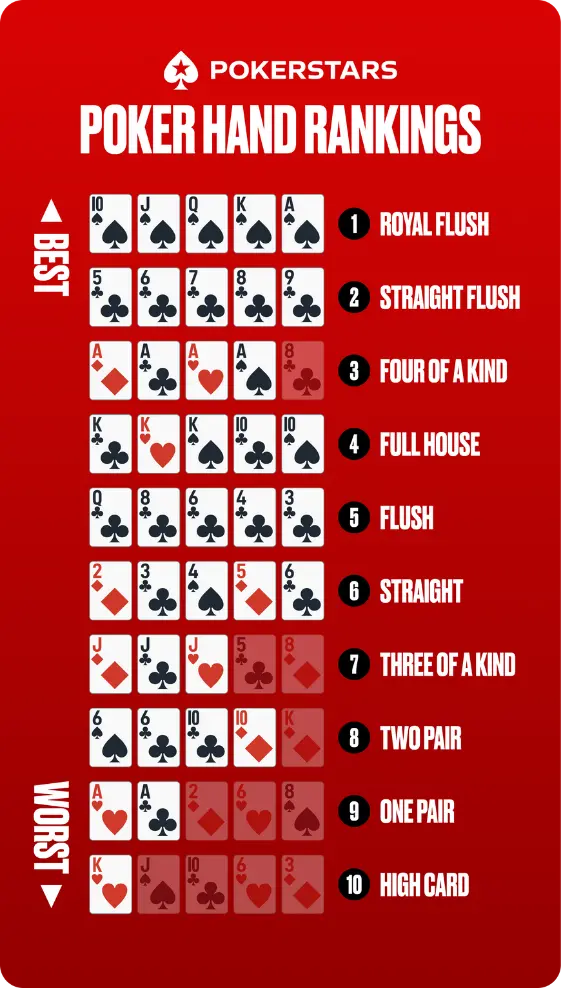
Traditional High Poker Hand Ranks
In this section, we're looking at the 'traditional' rankings used in games like Texas Hold'em and Omaha. However, if you want to checkout lowball rankings, we've also included these further down the page:
- Ace to Five (‘California’) low hand rankings for low hands, used in Omaha Hi/Lo, Razz, and Stud Hi/Lo.
- Deuce to Seven (‘Kansas City’) lowball rankings for low hands in 2-7 Single Draw and 2-7 Triple Draw.
Royal Flush
.webp)
What is it? An ace, king, queen, jack, and ten of the same suit.
What does it beat? Everything! The royal flush is unbeatable.
What happens in a tie? It’s only possible for two players to have a royal flush in stud or draw games, and in this scenario, they split the pot. In games that use community cards, like Texas Holdem, it is not possible for two players to make a royal flush at the same time.
Straight Flush
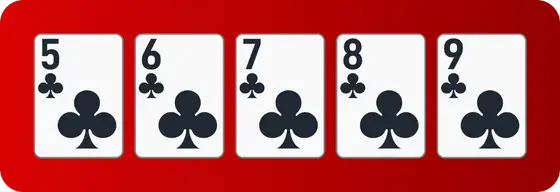
What is it? Five cards of the same suit in numerical order.
What does it beat? Everything aside from Royal Flush.
What happens in a tie?The highest rank at the top of the sequence wins.
Four of a Kind
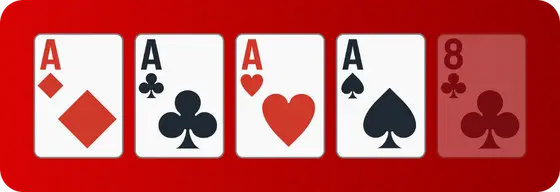
What is it? Four cards of the same rank plus one side card (the “kicker”).
What does it beat? Full house and all lower hands.
What happens in a tie? Highest four of a kind wins. If players share the same four of a kind, the higher kicker wins.
Full House
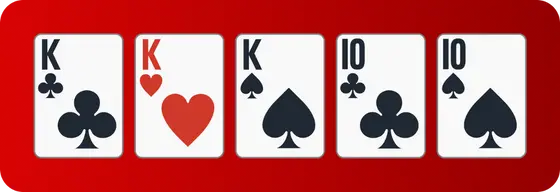
What is it? Three cards of one rank plus two cards of another matching rank.
What does it beat? Flush and all lower-ranking hands.
What happens in a tie? Highest three-of-a-kind portion wins. If those are identical, the pair portion with the higher rank wins.
Flush
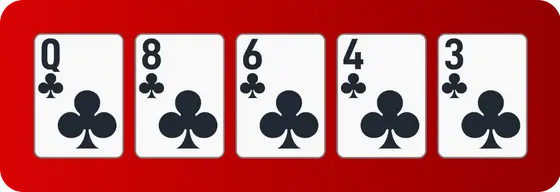
What is it? Five cards of the same suit.
What does it beat? Straight and all lower hands.
What happens in a tie? Highest card wins, then second-highest, third-highest, fourth-highest, and fifth-highest if needed. If all five cards are identical in rank, the pot is split. Suits are never used to break ties.
Straight
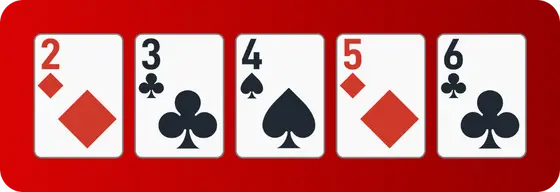
What is it? Five cards in sequential order. The ace can be high (A-K-Q-J-10) or low (5-4-3-2-A).
What does it beat? Three of a kind and all lower-ranking hands.
What happens in a tie? Highest top card in the sequence wins.
Three of a Kind
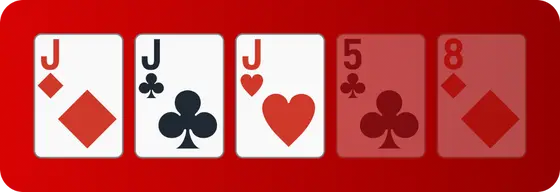
What is it? Three cards of the same rank plus two unrelated side cards.
What does it beat? Two pair and all lower hands.
What happens in a tie? Highest three-of-a-kind wins. If identical, compare the highest side card, then the second.
Two Pair
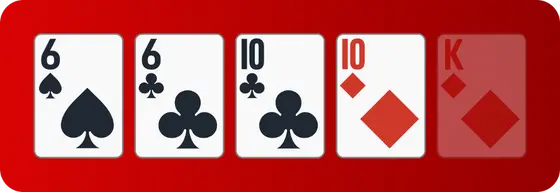
What is it? Two cards of one rank, two cards of another rank, plus one side card.
What does it beat? One pair and high card.
What happens in a tie? Highest pair wins. If identical, the second pair is compared. If both pairs match, the highest kicker wins.
One Pair
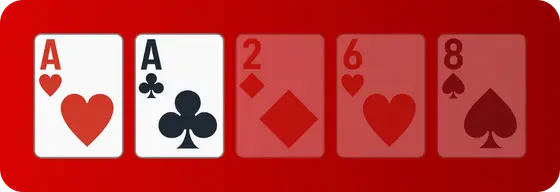
What is it? Two cards of the same rank plus three unrelated side cards.
What does it beat? High card.
What happens in a tie? Highest pair wins. If identical, compare the highest side card, then the second, then the third.
High Card
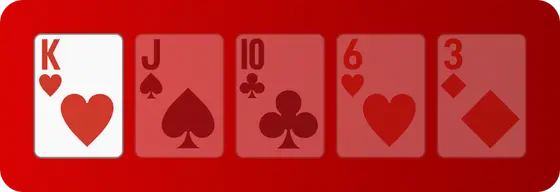
What is it? Any five-card hand that doesn’t fit into another category.
What does it beat? Nothing, except another high card hand.
What happens in a tie? Highest card wins. If needed, compare the second-highest, third-highest, fourth-highest, and lowest card.
Poker Hand Scenarios: Who Has the Best Hand?
Let’s test your hand rankings knowledge with some example hand scenarios.
In this first scenario, two players are left in the pot and it’s time for the showdown. Who has the best hand here?
.webp)
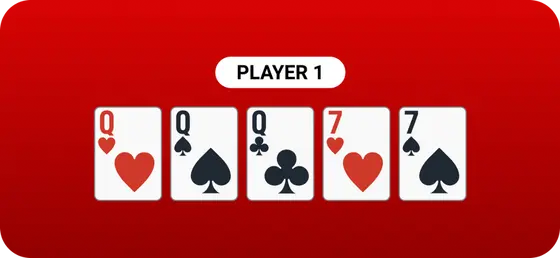
Here, although Player 2 has a Flush, which is a good hand, Player 1 can form a Full House by combining their two queens with the queen clubs and two 7’s from the board:
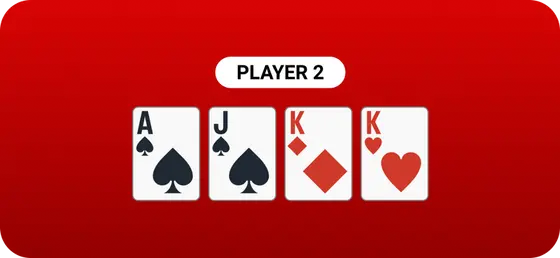
Try this scenario. Again, there are two players left in - who’s taking the pot?
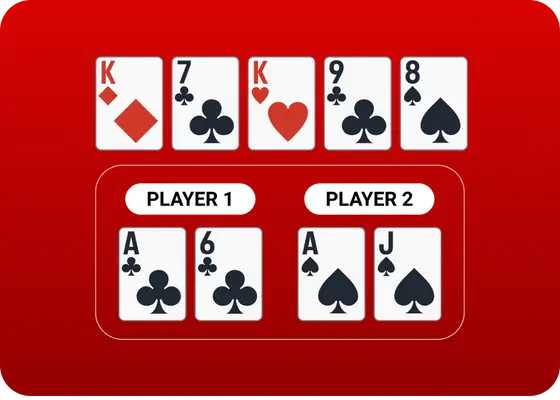
This time, no player has a particularly good hand, but they can both use the kings to make a Pair. However, Player 2 wins courtesy of their jack kicker.
Ready to Play?
Ready to test your poker strategy? Remember, you can use our poker game guides when you play!
- Play PokerStars easily in your browser or download PokerStars on mobile or desktop.
- You can also play free online poker with PokerStars. Just select 'Play Money' in the poker software.
- PokerStars Home Games are an ideal way to begin playing poker at home with friends and try out your strategy at the same time.
Other Poker Hand Rankings
As well as the traditional hand rankings used in games like Texas Hold’em and Omaha, there are other hand rankings used for different versions of the classic poker game.
Ace To Five Lowball Hand Rankings
One of these hand rankings is the ‘Ace to Five’ low hand rankings, sometimes called ‘California Lowball’. This version is used in games like:
..as well as many other poker games.
As you might expect, in this version of poker, the lowest hand wins. But what else is key to know when you play?
Here’s our quick explainer:
- The aim is to have the lowest five-card hand: This format inverts the classic hand rankings, so your objective is to form what would be considered a ‘low-ranked’ hand.
- The lowest possible hand is 5-4-3-2-A: This hand is the equivalent of a royal flush in traditional poker.
- Aces are always low: Pay attention to the ace when building your ‘best’ low hand.
- Suits are irrelevant: Straights and flushes don’t count against a hand.
Ace To Five Lowball Hand Ranks from Best to Worst
We detail all the Ace to Five hands you need to know below, but before we get to that, here are the Ace to Five Lowball hand rankings, going from best (most likely to win a round) to worst (least chance of winning).
- Five Low, or Wheel: The Five, Four, Three, Deuce and Ace.
- Six Low: Any five unpaired cards with the highest card being a Six.
- Seven Low: Any five unpaired cards with the highest card being a Seven.
- Eight Low: Any five unpaired cards with the highest card being an Eight.
Five Low (Wheel)
What is it?
A Five Low consists of 5-4-3-2-A. Suits do not matter, and straights or flushes do not affect the hand.
What does it beat?
All qualifying low hands worse than Five Low, including any Six Low, Seven Low, Eight Low, etc.
What happens in a tie?
All Five-high hands split the pot.
Six Low
What is it?
Any five unpaired cards where the highest card is a Six (for example: 6-4-3-2-A).
What does it beat?
All Seven Low, Eight Low, and weaker lows. It loses to any Five Low.
What happens in a tie?
The second-highest card determines the winner. For example, 6-4-3-2-A beats 6-5-4-2-A.
Seven Low
What is it?
Any five unpaired cards where the highest card is a Seven.
What does it beat?
All Eight Low and weaker low hands. It loses to any Six Low or Five Low.
What happens in a tie?
The lower second-highest card wins. If necessary, the third-, fourth-, and fifth-highest cards break the tie.
Eight Low
What is it?
Any five unpaired cards where the highest card is an Eight.
What does it beat?
It only beats Nine Low and any weaker lows. In Omaha Hi/Lo and Stud Hi/Lo, it is the weakest hand that still qualifies for low.
What happens in a tie?
The lower second-highest card determines the winner. If needed, the remaining cards break the tie.
Deuce To Seven Lowball Hand Ranks
The Deuce to Seven Lowball hand rankings are the exact opposite of the traditional ‘high’ hand rankings. Therefore, the worst possible hand in traditional high poker – seven-five high, with different suits, becomes the best possible hand in deuce to seven lowball (a ‘perfect seven’ low or ‘wheel’).
This format is used in games such as:
In Deuce to Seven, the goal is simple: Make the lowest possible five-card hand.
But unlike Ace to Five Lowball, aces are always high, and straights and flushes count against you. This means that the absolute best possible low hand is: 7-5-4-3-2 (with no flush).
This hand is the equivalent of a royal flush in traditional poker—a true monster.
Deuce to Seven Poker Hands Ranked From Best to Worst
Here are the core Deuce to Seven lowball hands, ranked from best to worst:
- Seven Low: The best possible low is 7-5-4-3-2
- Eight Low
- Nine Low
- Ten Low
- Jack Low (and worse)
Any hand containing an ace, straight, flush, or pair is considered worse within its category.
Seven Low
What is it?
The strongest possible 2–7 low hand. Any five unpaired cards with a seven as the highest card, without forming a straight or flush.
What does it beat?
All Eight Low, Nine Low, Ten Low, and worse hands. It is the absolute top of the Deuce to Seven ranking system.
What happens in a tie?
The lower second-highest card wins. For example, 7-6-4-3-2 loses to 7-5-4-3-2. If necessary, the players would continue comparing each card downward.
Eight Low
What is it?
Any unpaired five-card hand in which the highest card is an Eight (and neither a straight nor a flush).
What does it beat?
All Nine Low, Ten Low, and weaker hands. Loses to any Seven Low.
What happens in a tie?
Highest card compared first, then the next highest, and so on. Example: 8-6-4-3-2 beats 8-7-5-3-2.
Nine Low
What is it?
Any unpaired hand with a Nine as the highest card, without making a straight or flush.
What does it beat?
All Ten Low and worse hands. Loses to any Eight Low or Seven Low.
What happens in a tie?
Compare the second-highest card downward until a difference is found.
Ten Low
What is it?
Any unpaired hand with a Ten as the highest card, as long as it does not form a straight or flush.
What does it beat?
It only beats Jack Low and weaker hands. It loses to any Nine Low or better.
What happens in a tie?
The lower second-highest card wins, and the remaining cards break ties if needed.
Poker Hands Frequently Asked Questions
A royal flush is the best hand in many variants of poker – ace, king, queen, jack and 10, all of the same suit. This hand cannot be beaten in ace-high games.
A royal flush is a type of straight flush – five suited cards in numerical order. In the event of a tie where more than one player has a straight flush, the highest ranked card at the top of the sequence wins.
As shown in the hand ranking explanations above, traditional poker hands are ranked in the following order:
- Royal flush
- Straight flush
- Four of a kind
- Full house
- Flush
- Straight
- Three of a kind
- Two pair
- One pair
- High card
These traditional hand rankings are used in popular poker formats such as Texas Hold’em and Omaha.
Knowing when to fold is one of the most important skills in poker, especially at the start of a hand. It’s worth considering how your cards rank before the flop – the higher the cards, the stronger they could be.
If you’ve got cards of the same suit you’ll also have an increased likelihood of achieving a flush. If you have closely ranked cards, you could be more likely to form a straight.
After the flop, you might want to think about folding in the following situations: if your pre-flop hand is no longer as strong, if players are betting/raising big and they don’t usually, or if you have a pocket pair but two or more stronger overcards have been dealt.
For more information on poker strategy, including tips and tactics, head here.
Three aces is the highest form of three of a kind. Taking into account that logic, three of a kind will not rank higher than a straight, flush, full house, four of a kind, straight flush or royal flush.
The fastest method is to remember that hand strength and how rare a hand is go together. So, the harder a hand is to make, the higher it ranks.
You can make a quick start on learning hand rankings by grouping hands into different levels of value, like ‘strongest’, ‘medium’, and ‘weak’, for example, and practice by using free poker quizzes to test yourself on hand strength.
We’d also recommend using our free hand rankings chart when you start playing. You can refer to the chart when assessing your hand, which will help you memorize the rankings.
No. In standard poker, suits never determine the winner, and all are treated as equal no matter whether you have a flush, a straight, or a high-card situation. If every relevant card is identical between players, the pot is split. This is one of the most common misunderstandings among beginners.
A kicker is a side card used to break ties when players share the same main hand, such as a pair or two pairs.
For one pair, the remaining three cards are compared, whilst for two pair, the kicker is used after both pairs are compared. For three of a kind, the two unmatched cards decide the winner. Kickers often determine the outcome of close Texas Holdem hands.
Yes. In Texas Holdem, your best hand can be made using both hole cards, one hole card, or none at all. When you use all five community cards to make your hand, it is known as ‘playing the board’, and can result in a tie and split pot if another player does the same. The exception here is when one player has a stronger kicker using a hole card.
The Ace is the only card that can act as both the highest and lowest card in a straight. It can form A-2-3-4-5 (the lowest straight) or 10-J-Q-K-A (the highest straight).It cannot, however, be used to form a straight in the middle of a ‘non-standard’ hand where it acts as both a high and low card, such as Q-K-A-2-3. Due to the unique way that the ace can be used, it’s an important fundamental to learn when starting to play poker.
Want to know more?
Check out our related poker guides: