


How to Play Texas Hold'em: The Complete Guide for Beginners
Texas Hold'em is the world’s most popular poker game because it's easy to learn but offers plenty of opportunities for strategy and advanced gameplay, once you learn the basics.
Whether you’re just starting out or brushing up your knowledge, this guide breaks down exactly how to play Texas Hold'em, including rules, betting rounds, hand rankings, strategy tips, and the differences between No Limit, Pot Limit, and Limit Hold'em.
What you’ll learn:
- What Texas Hold'em poker is.
- The basic rules of Texas Hold'em Poker.
- Understanding the Button, Blinds and Bets.
- Texas Hold'em Betting Rounds.
- The Best Starting Hands in Texas Hold'em
- No Limit, Pot Limit, Limit and Mixed Texas Hold'em.
What is Texas Hold’em Poker?
Texas Hold'em is a poker game where the objective is to create the best five-card hand using a combination of:
- Two private ‘hole cards’.
- Five shared ‘community cards’.
The ‘best’ hand is measured by using the poker hand rankings, which show poker hands ranked from best (or most valuable) to worst (least valuable).
Although the rules are simple, Texas Hold'em also includes elements of critical decision-making, including hand selection, bet sizing, player position, and more.
Check out our Texas Hold'em video guide to learn the rules in 60 seconds. (in Spanish)
Texas Hold'em Rules (Step-by-Step)
Here’s how a standard hand of Hold'em works:
- Each player receives two private hole cards.
- Five community cards are dealt face-up in three stages:
- The Flop: Three cards are dealt.
- The Turn: One more card is dealt.
- The River: One final card is added.
- Players bet before the flop (called ‘Pre-flop’), after the Flop, after the Turn, and after the River.
- Players must match the current bet to continue in the hand.
- The best five-card poker hand wins the pot.
- Players can use any combination of their seven available cards, including using both hole cards, one hole card, or even none.
Play Texas Hold'em Online
You have a few options to put your Texas Hold’em knowledge to the test:
- Play real money poker directly in your browser, or by downloading PokerStars on your device.
- Learn poker by playing with your friends in a PokerStars Home Game.
- Try a few free poker games by selecting the ‘Play Money’ option in the PokerStars software.
Understanding Blinds and the Dealer Button
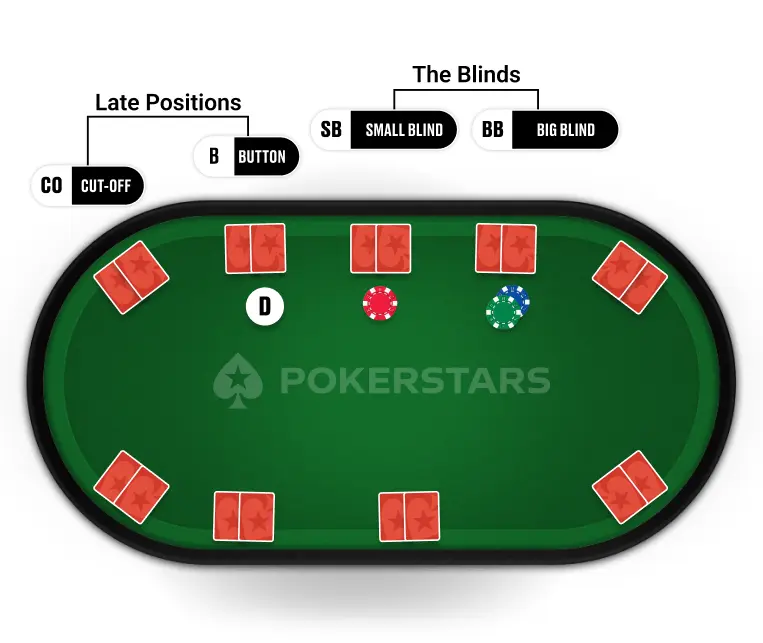
In Texas Hold'em, a round marker known as the Dealer Button (or simply 'the button') indicates who the nominal dealer is for that hand. This is a very important position in a poker game, since it determines where the betting action begins.
Before any cards are dealt, Texas Hold’em uses two forced bets, called the small blind and big blind, to start building the pot or ‘create action’.
- Small Blind: the player immediately clockwise (left) of the button.
- Big Blind: the player to the left of the small blind.
For example, in a €1/€2 No Limit Hold'em cash game:
- €1 small blind.
- €2 big blind.
Once the hand is complete, the Dealer Button rotates one spot clockwise. This ensures that the advantage of being the dealer (and the cost of paying the blinds) moves fairly to every player at the table.
In some formats, players may also post an ‘ante’ (a small forced bet from every player). Antes are most common in poker tournaments to encourage action.
Player Bets in Texas Hold'em
Your choices during a hand include:
- Check: Take your turn without betting.
- Bet: Put chips into the pot when no one else has bet.
- Call: Match another player’s bet.
- Raise: Increase another player's bet.
- Fold: Give up your hand and forfeit any claim to the pot.
Which options you have depend entirely on the action before you.
Texas Hold'em Betting Rounds
Texas Hold'em has a predetermined betting order. During these rounds, the cards are dealt from the deck and added to the table.
Let's take a closer look at each betting round and examine what happens at each stage of a hand:
1. Pre-Flop
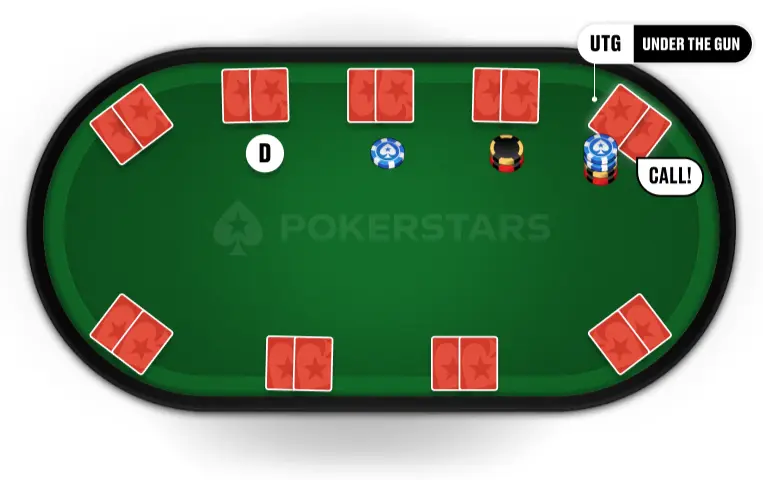
After the hole cards are dealt, each player can begin to play their hand. Betting starts with the first active player left of the big blind (called ’Under the Gun’ - UTG).
That player has the option to fold, call, or raise. Let’s say the big blind was €2 and you are under the gun. In that scenario:
- It would cost €2 to call.
- Or, at least €4 to raise.
2. The Flop
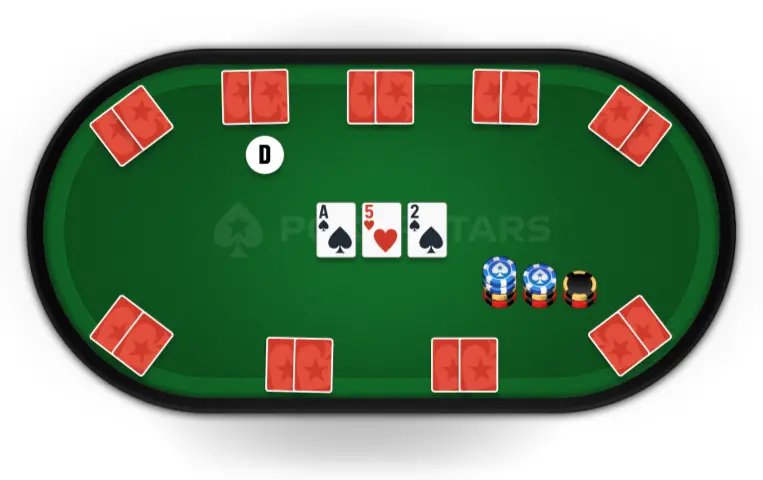
The flop is the first time that three community cards are revealed and dealt face up on the table. All players who are still in the hand can use these cards to begin forming their best five-card hand, in combination with their two hole cards.
Betting on the flop begins with the active player immediately clockwise from the button. The betting options are similar to pre-flop, with one crucial addition. If nobody has bet previously, players may check, passing the action to the next active player clockwise.
Note: The Dealer ‘burns’ (discards) the top card before dealing the Flop / Turn / River to prevent cheating.
3. The Turn
The turn starts with a fourth community card (‘Fourth Street’) being dealt and added to the first three community cards. Betting continues, beginning with the active player immediately clockwise from the button.

4. The River
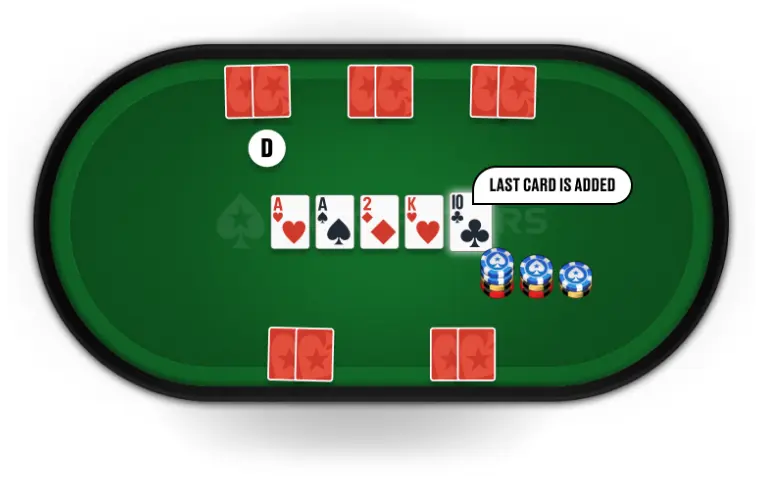
The fifth and final community card (the river or ‘Fifth Street’) is revealed, and the players who are still active in the hand now have the maximum number of cards to form their hand.
One last betting round determines whether players go to showdown or have to fold. Betting again begins with the active player immediately clockwise from the button, and the same betting rules apply as they do for the flop and turn.
5. The Showdown
The players left in the hand now show their hole cards, called ‘the showdown’. The last person to bet or raise on the river shows their cards, unless there was no bet on the final round. In this scenario, the player immediately clockwise from the button shows their cards first.
The best five-card poker hand is determined, and that player wins the pot.
If two players have the same hand (like a Pair of Aces), the winner is decided by the 'Kicker', which is the highest remaining card in their hand. Any tied hands share the pot.
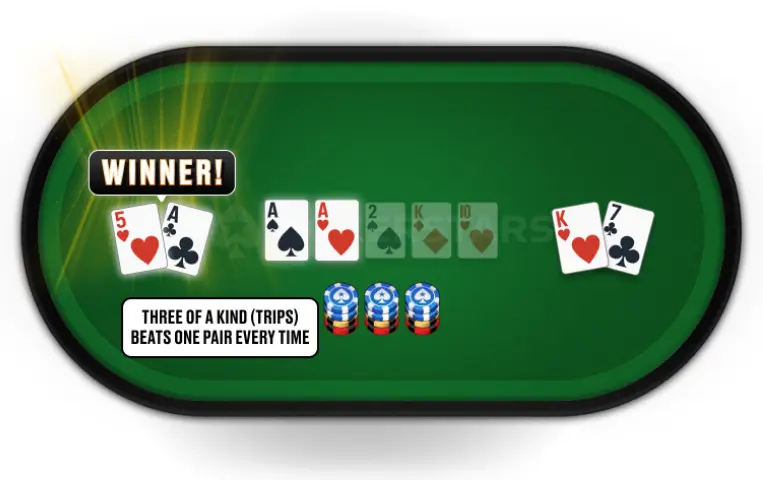
Texas Hold'em Starting Hand Combinations
There are 1,326 possible combinations for your opening hand in Texas Hold'em poker. However, because suits have no value in this poker variant, a lot of these combinations will have the same value before the flop.
When suits are ignored, there are 169 unique starting hands in Texas Hold'em. With that being said, having cards of the same suit is incredibly valuable in this poker variant, as it gives you the potential to make a Flush, which is the fifth-best hand in the rankings.
In the pre-flop phase, Pocket Aces (AA) is the best starting hand in Texas Hold’em. However, if your hand doesn’t improve on the board when the community cards are added, you will only have one pair.

How you play your opening hand will depend on the game in question:
- In games with one other player (‘heads-up’ games), you will typically need to play an extremely wide range of starting hands, especially when on the button.
- When it comes to pots involving three or more players (‘multi-way’ pots), this may not be a strong enough hand for you to continue in later betting rounds, or to win the hand if it gets to showdown.
Starting Hand Selection Strategy
Starting hands that have strong playability generally include the following:
Premium Pairs (AA, KK, QQ, JJ)
Hand quality: AA and KK are the premium starting hands in Texas Hold'em, with QQ and JJ the next best pairs.
How to play: AA and KK can be played extremely confidently and aggressively pre-flop, and you shouldn’t be deterred from getting your stack in the middle at this stage if you get the opportunity. Proceed carefully with JJ–QQ on ace- or king-high flops.
Small & Medium Pairs (22–99)
Hand quality: Small (22-66) to middle (77-99) pairs, have good playability, especially when in a late position.
How to play: Good to play in late position if you can see a flop relatively cheaply, to try and hit a set on the flop. Folding is recommended against a lot of pre-flop action, or if you face a bet after missing the flop.
Suited Connectors (e.g., 9♠8♠, J♥10♥)
Hand quality: Cards with consecutive numbers and the same suit (e.g. J♥, 10♥) have great playability post-flop and can give you the chance to make straights or flushes.
How to play: It’s recommended that you play a lot of these hands multi-way and/or when you have a large stack of chips (a ‘deep stack’). You have the potential to win large pots against players with inferior holdings like two pair or three of a kind.
Suited Aces (e.g., A♣5♣, A♥4♥)
Hand quality: Hands like A♥, 4♥ give you the potential to make straights, but more importantly, the best possible flush (the ‘nut flush’).
How to play: This type of hand can be extremely profitable against players with inferior holdings, especially players who may also hit lower-value flushes.
In addition, suited aces are great bluffing hands against pre-flop raises. Holding an ace means you block the combinations of aces that your opponent(s) can be holding. And if you’re called, your holding still has decent playability post-flop.
Texas Hold’em Hand Rankings (Best to Worst)
Understanding hand rankings beyond your starting hands is important as you look to play your best possible five-card hand from the seven available cards.
Texas Hold’em poker uses traditional high poker hand ranks:
- Royal Flush – 10-A of the same suit
- Straight Flush – Five cards of the same suit, in consecutive order numerically
- Four of a Kind – Four cards of the same rank, and one side card/’kicker’
- Full House – Three cards of the same rank, and two other cards which also match rank
- Flush – Five cards of the same suit
- Straight – Five cards in sequence numerically
- Three of a Kind – Three cards of the same rank, and two unrelated side cards
- Two pair – Two cards of matching ranks, another two cards of matching rank, and one side card
- One pair – Two cards of matching rank, and three unrelated side cards
- High card – No matching cards and no other hand type
More information on hand ranks, including examples of poker hands, is available in our How to Play section.
All suits are valued equally.
Betting Types: No Limit vs Limit vs Pot Limit
There are typically three types of Texas Hold'em games: Limit, No Limit, and Pot Limit, as well as a Mixed game.
Whilst the rules are the same, there are some differences in betting:
| Feature | No Limit Hold'em (NLHE) | Pot Limit Hold'em (PLHE) | Limit Hold'em (LHE) |
| Minimum Bet | Size of the Big Blind | Size of the Big Blind | Fixed (Size of Big Blind) |
| Maximum Bet | All-In (All your chips) | The size of the current pot | Fixed (Structured Limit) |
| Raise Rules | Min. raise must match previous raise | Min. raise must match previous bet | Fixed increments only |
| Raise Cap | Unlimited raises | Unlimited raises | Capped (Usually 4 bets per round) |
| Game Style | High risk, explosive pots | Strategic drawing, math-heavy | Low variance, consistent grinding |
No Limit Hold'em (NLHE)
- Minimum bet is the big blind.
- Maximum bet is all your chips. In poker terms, this is referred to as ‘All-In’ and it is the most iconic phrase in No-Limit Hold’em.
- Minimum raises must be at least the size of the previous raise.
- In No Limit Hold'em, there is no ‘cap’ on the number of raises allowed.
Pot Limit Hold'em (PLHE)
- Minimum bet equals the big blind, but players can bet up to the size of the pot.
- Maximum bet equals the current pot size (including your call).
- Minimum raises must be at least as much as the previous bet or raise in the same round.
- Like No Limit Hold'em, in Pot Limit Hold'em, raises are unlimited.
Limit Hold'em
- Betting in Limit Hold'em is fixed, and the amounts are structured and pre-determined.
- Pre-flop and flop betting must be the same size as the big blind, including raises.
- Turn and river, bets and raises are doubled.
- In Limit Hold'em, up to four bets are allowed per player during each betting round. This includes a (1) bet, (2) raise, (3) re-raise, and (4) cap (final raise).
Mixed Hold'em
- In Mixed Hold'em, the game switches between rounds of Limit Hold'em and No Limit Hold'em.
- The blinds are typically increased when the game switches from No Limit to Limit, to ensure some consistency in the average pot size in each game.
- The betting rules on each round follow the rules for that game, as described above.
In the PokerStars software, it’s not possible to bet less than the minimum or more than the maximum. The bet slider and bet window will only allow you to bet amounts within the allowed thresholds.
Learn How to Play Texas Hold'em for Free
Reading the rules is only the first step. To truly understand Texas Hold'em, you need to experience the flow of the game and play a few hands yourself.
For beginners, start at the Play Money tables and play free poker games here at PokerStars Spain. These are dedicated games where you use free "virtual chips" instead of real money.
Free poker is the perfect sandbox to:
- Get comfortable with the software, including using the bet slider and action buttons without pressure.
- Test your starting hands: See which hands actually win at showdown.
- Make mistakes for free: Misread the board? Bet too much? In Play Money games, learning from errors costs you nothing.
Texas Hold'em FAQs
During a game of Texas Hold’em, players are trying to win the pot – the sum of all the bets that have been played in that hand. A player will win the pot if they have the best five-card hand at the showdown.
In the instance where all but one player has decided to fold, the remaining player will win the pot without having to show their hand.
Success in Texas Hold’em games often relies upon strategy. Considering the following elements can be a good way to start developing your optimal Texas Hold’em strategy:
- Choose to play opening hands that are more likely to make you money in various situations. Are you ‘on the button’? Think about what others have done and make the most of being in a stronger table position.
- Think about your potential hands and what others are likely to do at the table when sizing your bets. Again, position can play a big part in your decision-making here.
- Folding and knowing when you’re beaten is a skill that can help you maintain your stack/buy-in and your success/bankroll in the long run. Learn when it’s best to fold and move onto the next hand
Practice and experience can be key when it comes to developing a successful poker strategy. PokerStars offers free-to-play games where players can hone their skills, as well as a range of strategy tips and advice.
Each player receives two private cards, known as hole cards. These remain face-down and only you can use them.
There are five community cards dealt face-up on the table: three on the flop, one on the turn, and one on the river.
The best starting hand is Pocket Aces (AA). It has the highest winning probability against any random hand before the flop.
Hands rank from highest to lowest as follows: Royal Flush, Straight Flush, Four of a Kind, Full House, Flush, Straight, Three of a Kind, Two Pair, One Pair, and High Card. The Royal Flush is the unbeatable hand in Texas Hold'em.
The big blind and small blind are forced bets that start the action in each hand. The player left of the dealer posts the small blind; the next player posts the big blind.
- Check: Take your turn without betting.
- Call: Match another player’s bet.
- Raise: Increase the size of the current bet.
No. You can use both, one, or none of your hole cards. The best five-card combination always wins, regardless of how many hole cards are used.
Want to know more?
Check out our related poker guides: