


Poker Strategy
Poker Tips and Tactics
It’s been said that poker is easy to learn but hard to master. Poker rules and hand rankings are just the starting point for games like Texas Hold'em and Omaha, and once these are learnt, there are strategic tips you can explore.
This poker strategy guide offers tips to help you become a better online poker player, with general advice and strategy for beginners, as well as more advanced concepts to take your poker game to the next level.
Important note: We're using the word 'strategy' here as a way of learning more poker techniques, but it's important to remember that luck is also a contributing factor, as you have no control over the cards you receive.
Basic Poker Strategy - 6 Beginner Tips
Tip 1: Play Only When You Want to
Poker can be a serious study or simply played for fun. Either way, playing at a high level with the potential to win requires time and effort, and as a beginner, you’ll have to accept that you will lose a few games.
Regardless of whether you’re a beginner just starting out or a serious player competing for money, you should still be playing for the fun experience that poker can provide. This will help you perform better and make better decisions. As soon as you start to feel frustrated or tired, you should stop playing, as continuing will arguably lead to poor strategy and losing your bankroll.
Tip 2: Learn the Language and Phrases
Poker has many unique expressions - ‘bluff’, ‘bad beat’, ‘under the gun’, and so on, so beginners can feel confused and overwhelmed. If you learn the key terms, you’ll be able to follow what is happening in a game and can avoid feeling lost at the tables.
When you start playing, you won’t understand all the words being used, but if you’re not sure of what is being discussed, you can look up that term online or ask other players.
For help with this, check out our Poker Dictionary to get familiar with the jargon.
Tip 3: Make Good Decisions – the Results Will Follow
Even the best players have losing sessions, so don’t expect to win every time. Your goal should be to make the best possible decisions consistently, using what you know (or can deduce) about your hand, the cards on the table, and your opponents.
Decision-making in poker is linked to your playing style, so be patient but be prepared to play aggressively when you need to. On the other end of the scale, being ready to fold if you’re unsure about the strength of your hand is another underrated skill.
The better your decisions, the better your overall results.
Tip 4: Understand Poker Maths
Poker is a card game that uses incomplete information. Whilst luck is a factor, adopting a mathematical approach can help you to make the most of your cards.
If you want to increase your chances to win, you need to know what are considered to be good poker hands and how you can play to build them throughout the game. A key part of this can be done by knowing about poker ranges. A range covers all the different possible hands that a player can have in a specific scenario.
Assessing the strength of your range is a good skill to learn when constructing the optimum hand from the available cards.
Tip 5: Go Beyond Starting Hands
While starting hand selection is crucial, professional players gain the biggest edge after the flop. Skills such as calculating pot odds, recognizing betting patterns, bluffing effectively, and using position can greatly increase your lifetime winnings.
As more cards are revealed with the the turn, and then the river, you have more information to use when making an assessment about your next move.
We cover some of these tactics in the advanced strategy guide further down the page, but they are still important elements for a beginner to look at when learning how to gain the edge in a hand.
Tip 6: Avoid Tilt
Tilt means making decisions based on emotion, and can lead to less than optimal play and, ultimately, losses. This often comes after a bad beat (losing a hand despite having statistically strong cards).
If you’re tilting, take a break, and reassess your strategy. The game will always be there later.
Ready to Play?
- Play in your browser or download PokerStars on mobile or desktop.
- You can also play free online poker with PokerStars. Just select 'Play Money' in the poker software.
Advanced Poker Strategy: 5 Tips to Improve Your Game
If you have a good grounding of the basics of poker, including basic poker strategy, you might be looking to take your game to the next level.
That’s where an advanced poker strategy comes in. However, don’t be put off by the use of ‘advanced’ - these are all techniques that anyone can learn, once you’ve learnt the poker rules.
Tip 1: Learn Different Styles of Play
One of the things that makes poker such a fascinating game is the sheer variety of different approaches, styles and ways to play. Most styles can be broken down into a combination of the following:
- Tight: Cautious, few hands, low risk.
- Loose: Many hands, higher variance.
- Aggressive: Frequent betting to apply pressure.
- Passive: More calling than betting.
| Playing Style | What is it? | Advantages | Risks |
| Tight | A cautious style that involves playing only strong, selective hands. | Fewer mistakes and avoids weak spots. Strong hand ranges are harder to exploit. | Opponents may know you only play strong cards. |
| Loose | A style where many hands are played, including weaker or marginal ones. | You can surprise opponents and win big when you hit a good hand. | Higher variance, so can lose money quickly. |
| Aggressive | Frequent betting and raising to pressure opponents. | Wins many pots without needing the best hand. | Can lose big against strong hands. |
| Passive | Calling more than betting or raising. | Keeps pots small and avoids risk. | Easy to exploit. |
Think about your own approach when you play poker. Do any of the terms above describe you?
If your answer is ‘all of them and none of them’, you’re onto something. A strong player can change gears and mix styles when needed, but beginners should start with a tight-aggressive approach.
Adopting this style should make you comfortable with betting aggressively, which is essential for long-term success, while trying to play mostly good hands before the flop can help you learn discipline and prevent you from getting into too many difficult situations with marginal hands. As you gain more experience and improve your game, you will be able to loosen up and vary your style, but you should always try to stay aggressive.
Tip 2: Understand the Importance of Position
Position in poker refers to where players are positioned at the poker table, and therefore dictates the betting order.
The graphic below shows a standard poker game, and outlines the typical seat positions:
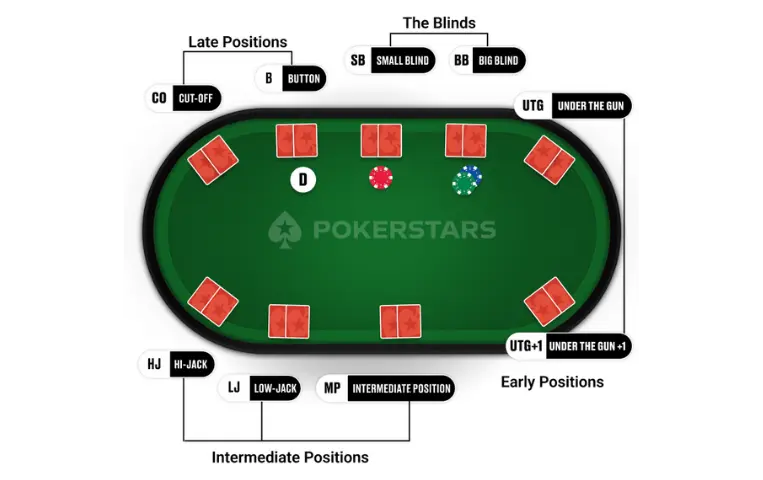
In simple terms, there are three types of position - Early, Middle and Late.
Early Position
Players in early position act first after the cards are dealt. These are the least advantageous positions as you must act before everyone else.
- Types of Early Position: Under the Gun (UTG), Under the Gun +1 (dependent on number of players).
- Best Strategy for Early Position: Play tight and stick to stronger hands.
Middle Position
Players in the Middle Position (MP) act after the early position but before the late position. This position offers a balanced mix of risk and information.
- Types of Middle Position: Middle Position (MP1), Lojack/Middle Position 2 (LJ/MP2) (dependent on number of players).
- Best Strategy for Middle Position: You can play a wider range of hands in Middle Position, but you should still be selective.
Late Position
In Late Position you act last on most betting rounds.
- Types of Late Position: Cutoff (CO), Button (BTN).
- Best Strategy for Late Position: Late Position is the most advantageous as acting last gives you key information about your opponents. Play more hands in late position and fewer in early position.
Find out more about position and why it’s important when playing poker with our video guide: (in Spanish)
Tip 3: Ensure Your Bluffs Make Sense
A ‘bluff’ is making a bet, even though you don’t have the best hand, in an effort to make the other players fold. Bluffing is a critical part of poker, and being able to ‘tell’ a believable story is an important factor in taking your poker game up a level.
When it comes to effective bluffing, consider how your actions appear to your opponent. If your line doesn’t match the strong hand you are representing, a smart opponent may call your bluff. Similarly, if you only act when you have a strong hand, your opponents may work out your game, and fold instead of adding to the pot.
Tip 4: Know Your Odds and Outs
Taking poker maths to another level, probability, and knowing poker odds can be a good way to gain an edge in your game. Poker odds allow you to assess your next action, and outs are the unknown cards required to complete a good hand.
- Odds express the likelihood of events, specifically in poker, the probability of hitting a specific hand.
- Outs are the unknown cards that improve your hand.
Let’s look at some examples:
If you hold two cards of the same suit and two more of that suit appear on the flop, you have four cards to a flush and need one more to complete it.
There are 9 cards remaining in the deck that can complete your flush draw (13 cards of each suit, minus the 4 already in play). These are your outs.
After the flop, with the turn still to come, there are 47 unknown cards remaining. Once the turn is dealt without completing your flush, there are 46 unknown cards left for the river.
To calculate your odds of hitting the flush on the river, take your 9 outs against the 46 remaining unknown cards:
9/46 = a probability of around 19.6%, or approximately 4.1 to 1 against.
Tip 5: Work Out Pot Odds
Pot odds compare the size of the pot to the amount required to call. Poker players will use pot odds to work out if a call is profitable or not. This comes down to two factors:
- If the pot offers worse odds than your chance of winning, fold.
- If the pot offers better odds, call.
Here’s a hypothetical scenario to explain how pot odds can be used in a game. Let’s say you’re heads up against one opponent, waiting to hit your last club on the river. There’s €10 already in the pot, and your opponent bets their last €10.
What’s the most effective play here?
You can call to add another €10, hoping to hit a flush, but the pot odds are 2 to 1, against the odds of getting a flush (4 to 1):
Taking a 4 to 1 risk for a payout of only 2 to 1 is a bad play; you might want to fold your flush draw.
But what if there was €100 in the pot? In that case, you are betting €10 to win €100, which means the pot odds are 10 to 1:
Against the same risk of 4 to 1, calling might be the best play.
Ready to Play?
Ready to test your poker strategy? Remember, you can use our poker game guides when you play!
- Play PokerStars easily in your browser or download PokerStars on mobile or desktop.
- You can also play free online poker with PokerStars. Just select 'Play Money' in the poker software.
- PokerStars Home Games are an ideal way to begin playing poker at home with friends and try out your strategy at the same time.
Poker Strategy FAQs
Poker strategy is a key element of a good poker player’s game and in the long term, poker strategy can help you make the most of your game. With this in mind, developing an optimal poker strategy and learning various elements of the game can lead you to being a more effective poker player. It's worth remembering that luck is still a contributing factor to poker, as you cannot control the cards you receive.
Every poker player is different and therefore there’s no ‘one-size-fits-all’ solution to define the most effective poker strategy. Effective poker strategies often take into consideration positions at the table, knowing why and when to bet, optimizing your bet size, and developing a good grasp of opposition behaviors.
The answer to this question is different for everyone. Some players prefer to learn by playing at the tables. The more they play, the more situations they experience and the better their poker strategy becomes. If this sounds like you, it might be worth testing out your skills at play money tables while you develop your game.
For others, studying away from the action can be important. There are loads of books, articles and courses out there to help inform your strategy. And then there’s the poker community – speaking to fellow poker players and following what’s said in forums and streams can be helpful.
Poker is a game of incomplete information, where maths and probability play a key role. There are a certain number of cards in the deck with a certain number of outcomes that can occur. Some players use their instinct, some players use the math, and some players use a mix of both to define their poker strategy.
Math-based players will consider the pot odds and equity to calculate if they should continue playing a hand. They will work out if their range of hands is ahead or behind of their opponent’s range based on the odds.
As well as learning poker rules and the hand rankings, the best strategy for beginners is learning to make consistent decisions and being disciplined. That includes learning the fundamentals, understanding position, and avoiding tilt.
The answer to this question is different for everyone. Some players prefer to learn by playing at the tables. The more they play, the more situations they experience and the better their poker strategy becomes. If this sounds like you, it might be worth testing out your skills on some free online poker games with our 'Play Money' option while you develop your game.
For others, studying away from the action can be important. There are loads of books, articles and courses out there to help inform your strategy. And then there’s the poker community – speaking to fellow poker players and following what’s said in forums and streams can be helpful.
Position is one of the biggest advantages in poker. Acting after your opponents gives you more information, allowing you to make better decisions. Play more hands in late position and fewer in early position to maximize this edge.