


How to Play Omaha Poker: The Complete Guide for Beginners
Omaha poker has rapidly become one of the most exciting and action-packed poker variants in the world. It follows similar rules to Texas Hold’em, but offers more opportunities to make higher-ranked hands, larger pots, and different poker strategies
In Omaha poker, every player receives four hole cards instead of two, as in Texas Hold’em. This opens up more possibilities for building a five-card hand.
In this guide, you’ll learn exactly how Omaha poker works, the rules you must follow, the best starting hands, and the differences between Pot Limit, No Limit, and Fixed Limit Omaha, along with a final FAQ section answering the most common beginner questions.
What you'll learn:
- What Omaha poker is.
- The basic rules of Omaha poker.
- The best Omaha poker starting hands.
- The differences between Pot Limit, No Limit and Fixed Limit Omaha.
What is Omaha Poker?
Omaha poker is a community card game similar to Texas Hold'em, where players receive four hole cards and must use exactly two of them combined with three community cards to make the best hand. Like Hold’em, five community cards are dealt on the board in stages, and players use them to make their best five-card hand, according to the poker hand rankings.
However, the key difference with Omaha poker, and the defining rule is:
Every player must use exactly two of their four hole cards and exactly three community cards to make their hand. No more, no less.
There are also multiple Omaha variants, including:
- Pot Limit Omaha Poker: A player can bet what is in the pot (i.e. €100 into a €100 pot). This is the most popular form of Omaha Poker.
- No Limit Omaha Poker: A player can bet any amount, up to all of their chips.
- Fixed Limit Omaha Poker: There is a specific betting limit applied in each game and on each round of betting.
- Omaha Hi/Lo (Omaha 8-or-better): where high and low hands split the pot
Regardless of the variant, the core rules and hand requirements remain the same.
Check out our Omaha video guide to learn the rules in 60 seconds. (in Spanish)
What are the Rules for Omaha Poker?
Learning the rules of Omaha is straightforward if you already know Texas Hold’em. The betting rounds are identical, but the gameplay is different, because players must navigate four hole cards and stronger hand ranges.
Below is a complete breakdown of how a standard Omaha hand works.
1. Blinds and Betting Structure
Just like Hold’em, Omaha uses a small blind and big blind to start the action. The type of Omaha game you’re playing (Pot Limit, No Limit, or Fixed Limit) determines how you can bet, but the blinds work the same way in all formats.
For example, a €1/€2 Pot Limit Omaha (PLO) game has a €1 small blind and €2 big blind.
In Fixed Limit Omaha, the big blind is the same as the small bet, and the small blind is typically half the size of the big blind, but may be larger depending on the stakes. For example:
- In a €2/€4 Limit game, the small blind is €1 and the big blind is €2.
- In a €15/€30 Limit game, the small blind is €10 and the big blind is €15.
2. The Deal
Each player is dealt four private cards face down, with the first player to the left of the dealer button receiving their cards first.
These are your hole cards, and you must use exactly two of them when making your final hand.
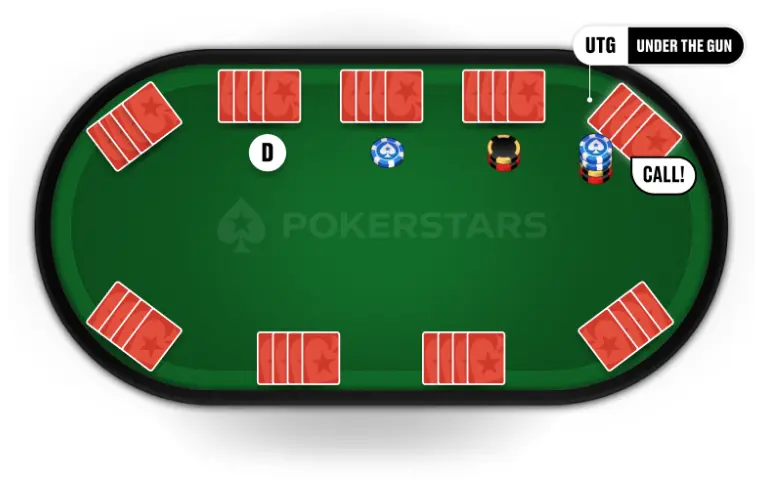
3. Pre-Flop
Starting with the player to the left of the big blind, players can now make a decision. You can choose to:
- Fold: Give up your hand.
- Call: Match the big blind
- Raise: Increase the bet (size depends on the variant)
Betting continues clockwise until all players have acted.
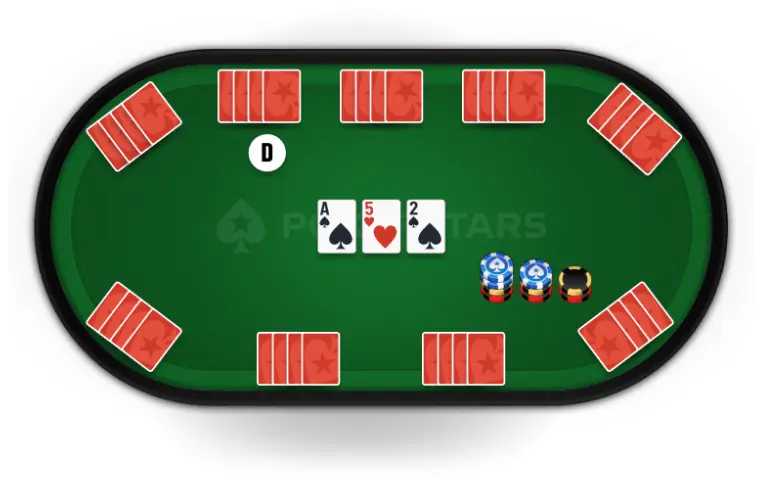
4. The Flop
Three community cards are dealt face up on the board, and a second betting round begins with the player immediately clockwise from the dealer button. In Fixed Limit Omaha, all bets and raises occur in increments of the small bet (for example, €2 in a €2/€4 game).
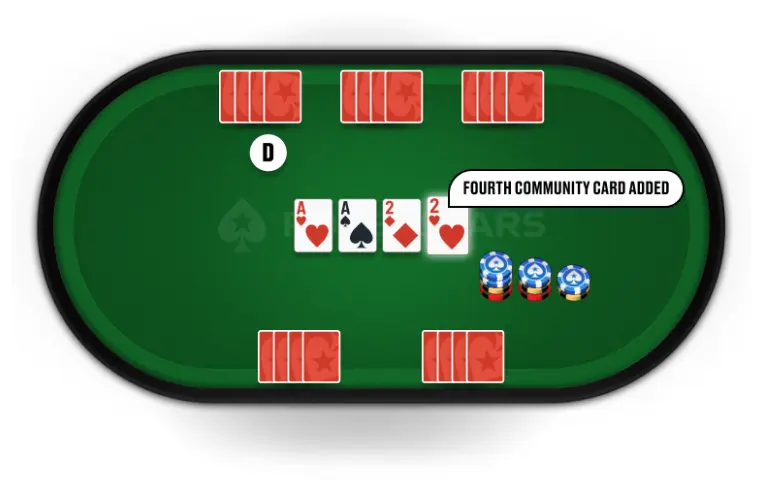
5. The Turn
A fourth community card is dealt face up, and another round of betting follows. In Fixed Limit Omaha, bets and raises on the turn are in increments of the big bet (for example, €4 in a €2/€4 game).
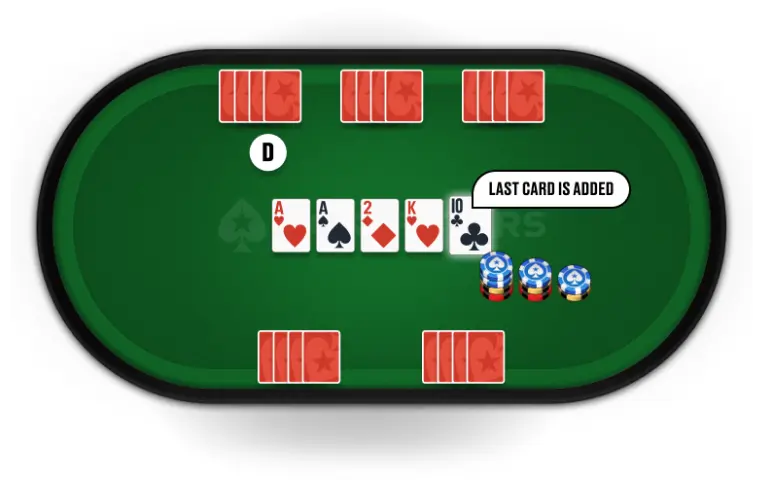
6. The River
A fifth and final community card is dealt face up. Players bet one last time, starting with the active player immediately clockwise from the button.
7. The Showdown
All remaining players reveal their cards, starting with the last player to bet or raise. If there was no bet in the final round, the player immediately clockwise from the button shows their hands first.
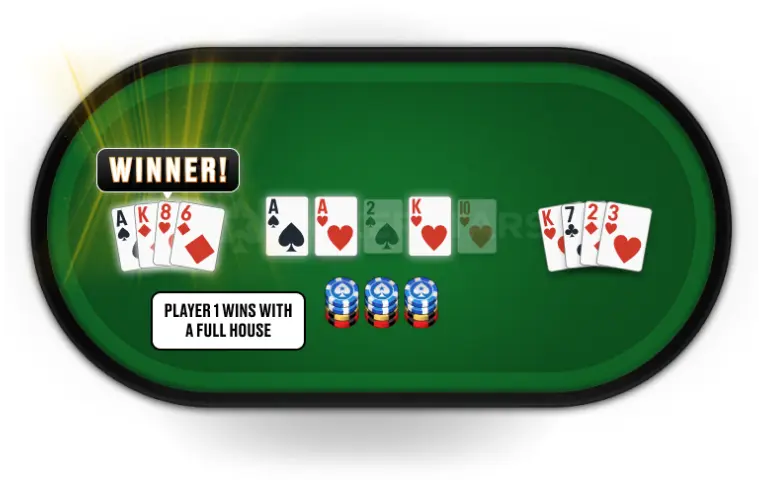
The best five-card hand wins the pot. HOWEVER, it’s important to remember that your Omaha poker hand must be:
EXACTLY 2 hole cards + EXACTLY 3 community cards.
If two or more players have identical best hands, the pot is split.
Omaha Poker Starting Hands
Starting hand selection is one of the biggest skill edges in Omaha. Because you receive four cards, the number of possible combinations is higher than in Texas Hold’em.
Here are the key concepts to understand.
The Best Starting Hands in Omaha Poker: Double-Suited Cards
The best starting hands in Omaha poker are double-suited hands. As you must use two of your hole cards in Omaha, having a ‘double-suited’ hand is a great start because it gives you two chances to make a flush.
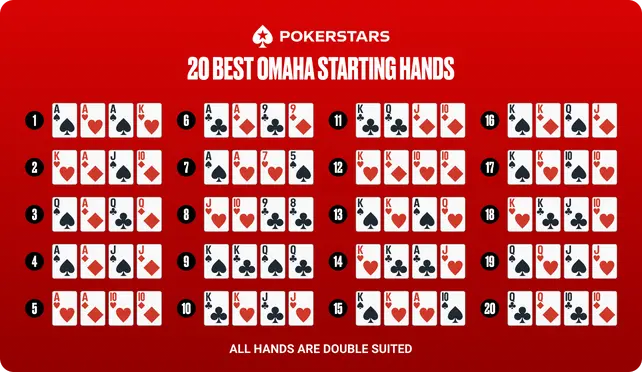
Here’s a list of what are regarded as the top ten starting hands in Omaha (they should all be ‘double-suited’):
- A-A-K-K
- A-A-J-T
- A-A-Q-Q
- A-A-J-J
- A-A-T-T
- A-A-9-9
- A-A-X-X (double-suited)
- J-T-9-8
- K-K-Q-Q
- K-K-J-J
Hands with two suited combinations, plus high card strength, are very strong pre-flop and post-flop.
Whilst Pocket Aces is a strong opening hand in Texas Hold’em, in Omaha, it often requires connectivity and suitedness to reach maximum potential.
Using Connectors
Hands that connect with each other, especially in sequences like 7s and 8d, provide the potential to build a straight.
Strong connected starting hands include:
- J-T-9-8
- Q-J-T-9
- A-K-Q-J
These hands offer multiple straight possibilities and dominate unconnected, 'dangling' hands.
Avoid ‘Danglers’
A ‘dangler’ is a card that doesn't connect or work with the other three cards in your hand. For example:
A♠ K♠ Q♥ 4♣ – the 4 in this hand is a dangler.
The more danglers you have, the weaker your overall hand becomes.
However, even a dangler can sometimes have value if it acts as a 'Blocker'. For example, if you hold the Ace of Spades in your hand but no other spades, you know for a fact that no opponent can have the Nut Flush, allowing you to bluff more effectively.
The Differences Between Pot Limit, No Limit, Fixed Limit Omaha
Although all Omaha variants share the same core rules, the betting structure dramatically changes the strategy and style of the game. The Omaha variants include Pot Limit Omaha, No Limit, and Fixed Limit Omaha:
| Feature | Pot Limit Omaha (PLO) | No Limit Omaha | Fixed Limit Omaha |
| Max Bet | The size of the pot | Your entire chip stack | Structured (Big Blind size) |
| Max Raise | The size of the pot | Your entire chip stack | Structured (2x the bet) |
| Raise Limit | Unlimited | Unlimited | Capped (Usually 4 bets per round) |
| Risk Level | High | Very High | Low/Moderate |
| Popularity | Most Popular | Rare | Niche |
Pot Limit Omaha (PLO)
Pot Limit Omaha is the most popular Omaha variant worldwide. Arguably, this version of Omaha creates bigger pots and allows players to maximise drawing hands.
Pot Limit Omaha betting rules:
- Minimum bets equal the size of the big blind.
- Maximum bets can be up to the size of the current pot.
- Minimum raises must be at least as much as the size of the last bet or raise.
- Maximum raises can be the size of the pot, which is defined as the total of the active pot, plus all bets on the table, plus the amount the active player must first call before raising.
- In Pot Limit Omaha, there is no ‘cap’ on the number of raises allowed.
Here's an example:
If the pot is €10 and an opponent bets €5, the pot is now €15. To raise 'Pot', you call the €5 (making the pot €20), and then raise €20. Total bet = €25.
Because players can only bet up to the pot, PLO balances risk and reward while still allowing for massive pots.
No Limit Omaha
No Limit Omaha is less common than its Texas Hold’em counterpart, but it is played in the same way. It’s suitable for players who prefer situations that allow them to go ‘all-in’, but it is also more volatile than other variants of Omaha.
No Limit Omaha betting rules:
- The minimum bet in No Limit Omaha is the same as the size of the big blind.
- Maximum bets can be as much as your entire chip stack.
- Minimum raises must be at least as much as the previous bet or raise in the same round.
- Maximum raises are, again, up to the size of your stack.
- As the name suggests, No Limit Omaha does not limit the number of raises allowed.
Fixed Limit Omaha
Bet sizes in Fixed Limit Omaha are structured and predictable.
- Pre-flop and on the flop, all bets and raises are of the same amount as the big blind.
- On the turn and the river, the size of all bets and raises doubles.
- In Limit Omaha, up to four bets are allowed per player during each betting round. This includes a (1) bet, (2) raise, (3) re-raise, and (4) cap (final raise).
Fixed Limit Omaha betting rules:
In a €2/€4 Limit game:
- Pre-flop & flop = €2 bets
- Turn & river = €4 bets
Each betting round allows players to bet, raise, re-raise or cap (the final raise).
In the PokerStars software, it’s not possible to bet less than the minimum or more than the maximum. The bet slider and bet window will only allow you to bet amounts within the allowed thresholds.
Omaha Hi/Lo (aka Omaha 8-or-better, Omaha 8, or Omaha/8)
In addition to Omaha poker, PokerStars also offers the popular variant of Omaha Hi/Lo. This version of Omaha splits the pot between the highest and lowest poker hands, giving the game a whole different feel.
Remember, a good starting hand in Omaha isn’t always a good starting hand in Omaha Hi/Lo as you’re not playing to win the low half of the pot.
Learn How to Play Omaha for Free
If you want to learn how to play Omaha, then download the PokerStars software and join any 'Play Money' games to play free online poker against other players. Unlike our real money poker games, since there is nothing at stake, you can be comfortable learning all the rules of Omaha.
As well as Omaha, we also offer many other poker variants. See our Poker Games page to learn more.
Omaha Poker FAQs
Yes. You must always use two hole cards + three board cards to form your final hand.
Omaha is played with one standard 52-card deck of cards. So, you know that none of your opponents can have the same hole cards as you.
Players receive four hole cards, creating more combinations and stronger draws. As a result, winning hands are often straights, flushes, and full houses, not just top pair or two pair.
Pot Limit Omaha (PLO) is by far the most popular Omaha variant worldwide, both online and in live poker rooms.
Premium hands are typically double-suited, highly connected, and contain high pairs. Examples include A-A-K-K, A-A-Q-Q, and J-T-9-8 double-suited.
Want to know more?
Check out our related poker guides: